To understand the heart of Indio, California, one must look upward into the towering canopy of date palm trees that line the desert horizon. Long before the Coachella Valley gained international renown as a music festival destination, it earned a very different title: the “Date Capital of the World.” Today, the Coachella Valley produces approximately 95% of all commercially grown dates in the United States, a multibillion-dollar agricultural powerhouse built on an exotic botanical experiment.
The story of how imported Middle Eastern palm shoots transformed a harsh, arid basin into a thriving agricultural kingdom is more than an economic success story—it is the foundational cultural narrative of Indio.
1. The Botanical Experiment: USDA Explorers in the Sahara
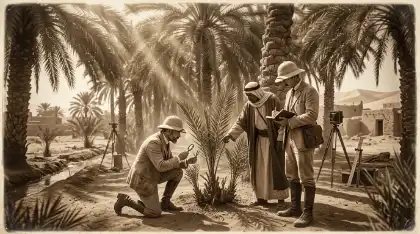
At the turn of the 20th century, agricultural scientists with the United States Department of Agriculture (USDA) were searching for crops that could flourish in the extreme heat and arid soil of the American Southwest. Recognizing that the Coachella Valley shared a climate remarkably similar to North Africa and the Middle East, USDA “plant explorers” traveled to regions such as Algeria, Iraq, Egypt, and Morocco to source premium date offshoots.
By the early 1900s, varieties like Deglet Noor, Medjool, Khadrawy, and Barhi were brought to experimental stations in Indio. Date palms require an unusual environmental combination—traditionally summarized as “feet in the water, head in the fires of heaven.” With access to deep underground aquifers via artesian wells and intense summer heat exceeding 100°F, Indio proved to be the ideal ecosystem for commercial date cultivation.
2. “America’s Arabia”: Architecture and Local Identity
As date groves expanded rapidly across the valley in the 1920s and 1930s, the unique crop captured the public imagination. Mid-century highway travel was booming, and Indio lean heavily into a romanticized, exotic “Arabian Nights” theme to attract curious tourists driving along historic highways.
The National Date Festival & Queen Scheherazade
In 1921, local growers organized the first date festival to celebrate the annual winter harvest. By 1947, this event officially became the Riverside County Fair and National Date Festival, complete with Middle Eastern-inspired architecture, street parades, and the crowning of Queen Scheherazade. To this day, the annual fair remains one of the longest-running civic traditions in Riverside County, drawing hundreds of thousands of visitors every February.
Architectural & Civic Heritage
The influence of the date palm went beyond the fields. Local street names, civic buildings, and roadside businesses adopted Moorish and Middle Eastern architectural flourishes—arched doorways, dome accents, and palm motifs—creating a distinct visual identity that sets Indio apart from neighboring desert cities.
3. Roadside Commerce and the Birth of the Famous Date Shake
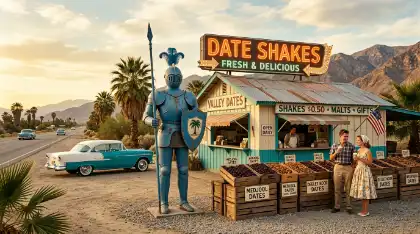
By the 1930s and 1950s, automobile tourism was transforming Southern California. Travelers making their way from Los Angeles through the desert needed pit stops, and local date growers stepped up with inventive roadside marketing.
Floyd Shields & The Date Crystal Innovation
Among the most famous pioneers were Floyd and Bess Shields, who established Shields Date Garden in 1924. Facing heavy competition, Floyd Shields invented and patented “date crystals”—a dried, pulverized date product that allowed the natural caramel sweetness of the fruit to be easily mixed into cold milk and ice cream year-round without requiring heavy refrigeration.
An Iconic Desert Culinary Staple
While multiple growers experimented with blended date drinks, the date shake quickly exploded into a global culinary phenomenon. Made by blending rich ice cream, milk, and concentrated date paste or crystals, the creamy treat became a non-negotiable rite of passage for motorists passing through Indio. Today, ordering an authentic date shake at historic stands remains an essential desert experience.
4. The Labor & Artistry Behind the Harvest
Behind the romantic roadside stands sits an intensely demanding agricultural process. Date palms do not self-pollinate efficiently in commercial settings, nor can they be harvested with heavy machinery.
For generations, highly skilled agricultural workers—known as palmeros—have maintained these historic groves. Palmeros climb trees reaching heights of 40 to 80 feet multiple times a year: first to hand-pollinate the female blooms in spring, then to wrap growing bunches in protective bags, and finally to hand-harvest the delicate fruit during the fall and winter months. The agricultural mastery of these farming families is the true engine keeping Indio’s cultural heritage alive.
Summary
Indio’s date farming legacy is a testament to human ingenuity and agricultural adaptation. From the early USDA plant explorations to the iconic roadside date shake, the humble palm shoot didn’t just grow in Indio’s desert soil—it defined the city’s architecture, culture, and community spirit for over a century.